
 Back
Back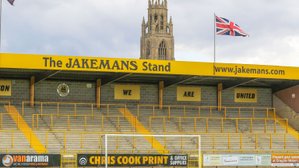
1. Detailed History
Although it was 1933 before the name Boston United first appeared, football had been played in the town since the late 1800s and, indeed, always on the same site as the York Street stadium. The first time that a team from Boston entered the FA Cup was in 1887. In the first round they were drawn against Gainsborough Trinity and were soundly thrashed 7-0. Those early years saw some spectacular defeats in the FA Cup, including a 9-0 defeat at Lincoln City in 1890 and in the following season Grimsby Town went one better to notch up a 10-0 win.
By the start of the First World War there were two clubs in Boston, Boston Town, whose headquarters were "The Coach and Horses" and Boston Swifts, who used "The Indian Queen" as their HQ. In fact, as both the public houses were situated on "Main Ridge" and the pitch was virtually just opposite, it wasn't surprising that for the first 40 years or so that was what the ground was called. A small stand was erected in the early 1900s but other than that there were no other facilities, and the teams changed at the back of the appropriate pub! Both teams were members of the Lincoln and District League.
After the First World War only one club, called simply Boston, emerged. After winning the Lincoln and District League in successive seasons, in 1921 the club joined the Midland League as a semi-professional side. In 1925 it went on to achieve the first Boston giant-killing in the FA Cup by beating the then-powerful Football League club Bradford Park Avenue 1-0 in the second round. The club was also achieving respectable positions in the Midland League, being runners up in 1924-25, behind Mansfield Town and again in 1926-27 behind Scunthorpe United. Both Mansfield and Scunthorpe were non-league sides at this time.
With entrances and dressing rooms at the west end, the ground was now known as "Shodfriars Lane." At the end of the 1932-33 season, the directors of Boston FC decided to wind up the club and they took the company into liquidation. Lack of success had meant that the club was not bringing in sufficient funds to make continuation of the Midland League side financially viable. It was proposed to keep football present in the town by running an amateur team in the Peterborough League. However, on July 3, a group of Boston FC supporters held a meeting in the Friendly Societies Hall to discuss an alternative proposal; to form a new club, to be called Boston United, that would take the place of Boston FC in the Midland League. There was enough support for the new proposal, so the new club was born and began playing in the summer of 1933. It was able to replace Boston FC in the Midland League and the Lincolnshire League, but was unable to get agreement from the FA in time to take over Boston's entry to the FA Cup for the upcoming season. The new club was also able to play on the Shodfriars Lane ground. For the first few games of the season they wore the blue strip of the old Boston side, but after a month they switched to black shirts with a white V-neck as they found that the blue shirts tended to fade and were looking untidy.
In January 1934, Ernest Malkinson, a local entertainment entrepreneur, was elected to the board. For most of the next 70 years, the Malkinson family, owners of the Gliderdrome bingo and dance hall, were one of the driving forces behind Boston United as the club established themselves as a major semi-professional side. In 1936, a player who is arguably the most famous to ever pull on a United shirt joined the club. It was Freddy Tunstall, the former Sheffield United and England winger. He had made seven appearances for England between 1923 and 1925 and was England captain for matches against Canada and France. He had also scored the only goal in the 1925 FA Cup Final when Sheffield United beat Cardiff City at Wembley Stadium in front of 91,763 fans. Tunstall was soon appointed as player-manager at Boston and went on to become the longest-serving manager in the club's history with a total of almost nine seasons in charge to his credit.
The club would find major success elusive until 1954 when they appointed former Derby County goalkeeper Ray Middleton as their new player-manager. Middleton put together a squad that would challenge for honours over the next few seasons. Many of his signings were from his former club and when Boston reached the second round of the FA Cup in 1955-56, Middleton was delighted to be drawn against Derby County at their Baseball Ground. With six former Derby players in the United team they won by an amazing 6-1 margin. This is still a record score by a non-league club against a League club on their own ground. A brave fight against Tottenham Hotspur in the third round wasn't enough to stop them going out. They also finished as runners-up to Peterborough United in the Midland League that season, their best-ever performance. Attendances at Boston at that time were averaging 5,000 to 6,000 for league games, and when floodlights were first used for the visit of Corby Town in 1955 over 9,000 people were in the ground!
In a search for more honours, and a Football League place, United joined the Southern League for the 1958-59 season, finishing third in the North Western Zone. A mid-table position was all that was gained the next year, while the following season saw them rock-bottom and they resigned and spent 1961-62 in the Central Alliance completing a league and cup "double." The next season they re-joined the "new" Midland League but by 1964 financial problems were at such a point they were forced to resign and to keep the club name alive while they sorted themselves out, they ran an amateur side in the local Boston and District league during 1964-65.
Season 1965-66 saw the start of the climb back to senior non-league football with a United Counties League and cup "double." Refused entry back into the Midland League in 1967, they became something of an oddity by being an east coast club playing in the West Midlands League! The travelling didn't seem to bother them as they won the championship both years and the League Cup as well in the second year. 1968 saw United as founder-members of the newly-formed Northern Premier League and the start of an 11-year period in which all kinds of honours were won and records were set.
Only twice were they not involved in the championship race, winning it a record four times. Boston were the first club ever to win a NPL "treble" of league, cup and shield. The League Cup was won twice, the NPL Shield four times and the non-league Champions of Champions Trophy twice. United also created a record of conceding only three goals at home in league games in a whole season, 51 consecutive home and away league games without a defeat, and 64 home league games (over three years) without a defeat. During this period a number of FA Cup triumphs over Football League opposition were gained and, notably, a return to the Baseball Ground in 1974 when they held Derby County, the team which would finish in third place in the league that season and win it the following season, to a 0-0 draw. The replay saw 11,000 spectators at York Street by which name the ground was now known and Derby through with few problems.
United received a huge body-blow in 1977 when Football League inspectors failed the ground as being suitable for the Football League, and although United were NPL champions yet again, runners-up Wigan Athletic were put forward instead and were elected. The United directors unanimously agreed that this must never happen again, and so commenced the vast undertaking of rebuilding virtually the whole of the York Street Ground, launching new fundraising schemes in 1978. The local population backed them incredibly, and new floodlights, stands, toilets, turnstiles, terracing and snackbars turned York Street into the stadium it now is.
Unfortunately, with priorities being centred off the field, memorable events as regards the playing side were few and far after United joined the Alliance Premier League in 1979 as founder members, third place was their highest ever placing in their first spell in the top non-league competition. The highest point they enjoyed was most certainly in 1984-85 when they celebrated 50 years by reaching Wembley in the FA Trophy final. Although they went down fighting 2-1 to Gola League Champions Wealdstone, there were over 12,000 Boston supporters that day in the crowd of 20,775. About 5,000 of them turned out again the next day to welcome the team back to Boston.
In the 1992-93 season the club finished bottom of the Conference and were relegated to the Northern Premier League. They did however also reintroduce a reserve side, playing in the TSW Printers Lincolnshire League, which consisted mainly of local players. In the 1995-96 season, United finished as runners-up in the UniBond League but an administrative error meant that they were unable to take the promotion spot and return to the Vauxhall Conference. At the end of the season, long serving chairman, Pat Malkinson "stepped down" allowing him to devote more time to his business commitments. Long-serving vice-chairman Sydney Burgess stepped up to take the reins and immediately introduced a new youth development scheme at York Street. The 1996-97 season saw United enjoy a good cup run for the first time in ten years, finally bowing out to Chester City by a 1-0 margin in the second round proper. They also reached the UniBond League Challenge Cup final, losing 1-0 to county rivals Gainsborough Trinity at Sincil Bank, Lincoln.
The 1997-98 season saw the Pilgrims pick up the runners-up trophy again in the UniBond League. The club also introduced a highly successful "Football For Life Scheme" under the guidance of Chris Cook. The youngsters on the scheme won the Lincolnshire Services League Cup at their first attempt and in a close-fought match, lost to Lincoln City Youth in the final of the Lincolnshire Charity Cup by a 2-1 margin. For the 1998-99 season, the Pilgrims moved sideways from the UniBond League into the Dr Martens League. After a poor start which saw them drop into a relegation spot, manager Greg Fee resigned and was replaced by the manager of Stamford AFC, Steve Evans. The turnaround in the club's fortunes was quite dramatic. Although it was always unlikely that Boston would catch up with runaway leaders Nuneaton Borough, they eventually claimed the runners-up spot. The club also had their best run in the FA Trophy since 1993, reaching the quarter-finals before being knocked out by St Albans City.
The Pilgrims finally won promotion back to the Conference after a seven-season absence in 1999-2000. They led the Dr Martens League for much of the season and clinched the title with a victory at York Street over local rivals Grantham Town in front of a huge crowd of over 4,000, with three games to spare. The reserve side won the Lincolnshire League for the first time, completing their matches without losing a single game. In their first season back in the Conference, after a slow start, which saw them go seven games without a win, they began to put the results together and eventually finished in 12th place.
For the 2001-2002 season, the club made the decision to go fully professional. This paid dividends when they went on to clinch the Conference title and promotion to the Football League. Boston were subject to an FA investigation in the summer of 2002, but proudly took their place in the Football League, drawing their first match 2-2 with AFC Bournemouth at York Street. Manager Steve Evans left the club during that summer, having been banned from football for 20 months.
However, new manager Neil Thompson worked a minor miracle to overcome the four-point deficit imposed on the Pilgrims and steer Boston to a respectable position of 15th place. The 2003-2004 season was another unsettled one in United's recent history, with a protracted takeover and a mid-season managerial change at the forefront of the off-field action. Steve Evans returned to the club and guided the Pilgrims to their highest-ever league placing of 11th, while the newly-formed Centre of Excellence also enjoyed a fine first season in existence, under the guidance of Daral Pugh and Neil Richardson.
The 2004-2005 campaign saw the Pilgrims reach the third round of the FA Cup for the first time in over 30 years, while the youth team replicated this feat by reaching round three of the FA Youth Cup. The first team finished the season in 16th place in the newly-renamed Coca-Cola League Two and striker Andy Kirk became United's first-ever current international, by playing for Northern Ireland during his time with the Pilgrims. Defender Austin McCann, signed from Hearts in the summer of 2004, had an excellent first season at York Street and was duly named "player of the year" by the United supporters.
The 2005-2006 season witnessed the Pilgrims claim 11th place in Coca-Cola League Two. The Pilgrims recorded their best-ever points tally in the Football League (61) as well as narrowly losing to Doncaster Rovers in the second round of the FA Cup.
The 2006-2007 campaign was a tale of woe for everybody involved at the newly-sponsored 'Staffsmart Stadium' with the season ending in relegation. Players were sold at regular intervals and the remaining squad members and staff went unpaid for the final two months of the season. The Pilgrims took their fight for survival to the last day at Wrexham, but after leading at half-time, United lost 3-1 to lose the Football League status they achieved five years earlier. Drewe Broughton scored eight goals during his loan spell from Chester City, but the Pilgrims were left to look ahead to their first season back in non-league football.
Worse news was still to follow in June 2007 though, with demotion to 'Blue Square North' confirmed after the Pilgrims entered a Company Voluntary Arrangement (CVA). It meant that United would begin the 2007-2008 season in the second tier of non-league football for the first time since 2000.
Chestnut Homes duo David Newton and Neil Kempster assumed control of the club in July 2007 and instantly set about trying to restore the club’s fine reputation of years gone by. They achieved notable success in May 2008 when they brought the club out of CVA — a feat achieved two years ahead of schedule.
The 2007-2008 season saw the Pilgrims finish 10th in Blue Square North, under the guidance of new manager Tommy Taylor. Paul Ellender, Stewart Talbot and David Galbraith were the only players to figure from the previous season’s squad and Taylor guided his new-look side to a top half finish against all the odds as Boston United finally started to show signs of recovery following a dark spell in the club’s history.
However, the Pilgrims were hit with another demotion in June 2008, when the club were removed from The Football Conference and placed in the UniBond Premier League — the third tier of non-league football.
United struggled to adapt and escaped relegation on the final day of the season by virtue of a 1-0 victory over Cammell Laird. Taylor and Steve Welsh had shared the managerial duties during the campaign, but the club appointed new joint first team managers ahead of the 2009-2010 season in the guise of Rob Scott and Paul Hurst, who had guided Ilkeston Town to promotion via the play-offs just weeks earlier.
The club's York Street ground was renamed "The Jakemans Stadium" in the summer of 2009 following a major sponsorship deal with Sutterton-based Jakemans Confectioners.
Scott and Hurst repeated their earlier promotion feat with Ilkeston by guiding Boston to promotion via the play-offs on May 1, 2010. The Pilgrims' 2-1 extra-time victory at Bradford Park Avenue added to the Lincolnshire Senior Shield and UniBond League Challenge Cup already collected during the season.
The 2010-2011 season in Blue Square Bet North was another memorable one, with a third place finish secured and another tilt at the play-offs. United trailed 1-0 to Guiseley after the first leg but won the second leg 3-2 after extra-time, only to be beaten on penalties. United’s surge into the play-offs was not hindered despite the ill-timed departure of Scott and Hurst to Grimsby Town in March 2011.
Jason Lee and Lee Canoville assumed control and guided the Pilgrims safely into the top five and were handed the joint managerial duties on a permanent basis ahead of the 2011-2012 campaign. The Pilgrims took time to adjust following the loss of several key players during the summer months but a strong run post-Christmas run took United to the brink of the play-off positions, although a poor run towards the closing weeks of the season ensured an eventual 11th placed finish.
Canoville departed ahead of 2012-2013, with Lee left to plot a sole route to success for the Pilgrims in a fiercely-competitive Blue Square Bet North division.
Lee himself departed in December 2012 following a poor run of form and his replacement Graham Drury, the former Stamford AFC manager, lasted an even shorter period of time. He was in charge until March 2013, encompassing 79 days, and was sacked following a run of two wins from 13 matches.
Dennis Greene arrived (in March 2013) and a three-match winning run alleviated any growing relegation fears although the Pilgrims finished in 16th place.
Greene was handed the managerial duties permanently ahead of the 2013-2014 season and responded by guiding the Pilgrims to a sixth place finish, only losing out on the play-offs on the final day of the campaign. United recorded 15 home victories out of 21, which was their best home record since 2000.
Greene was subsequently awarded a new two-year contract — tying him to the club until the end of the 2015-2016 season.
The 2014-2015 campaign was another of great excitement at The Jakemans Stadium, with the Pilgrims clinching a play-off place following more excellent home form, which included an unbeaten home run stretching from November until the end of the season. United were only denied a play-off final appearance by a sensational stoppage time leveller from Chorley’s Adam Roscoe — and subsequent penalty shootout elimination.
United reached the play-offs again in 2015-2016 following a fifth place finish in the newly-branded National League North. The Pilgrims led 2-0 after the first leg of the play-off semi-final but suffered a 3-0 second leg defeat to suffer an agonising exit at the hands of North Ferriby United.
Following a difficult start to the season in 2016-2017, Greene left the club by mutual consent and was replaced by former Mansfield Town boss Adam Murray in December 2016.
Murray guided the Pilgrims to mid-table safety during the closing weeks of 2016-2017 but resigned at the end of October 2017 after a tough start to the 2017-2018 campaign, to be replaced by upcoming Shaw Lane manager Craig Elliott.
Elliott masterminded a stunning turnaround of form to lift the Pilgrims from second-bottom in December to a final position of ninth in the National League North standings.
Elliott's first full season in charge in 2018-2019 led to a mid-table finish but 2019-2020, the club's last at York Street, was memorable for a variety of reasons. United reached the second round of the FA Cup and hosted a televised replay against EFL League One side Rochdale, watched by a crowd of over 4,000.
With the Pilgrims still well set for a tilt at the title, following a run of six successive league wins throughout January and February, the Coronavirus pandemic hit in March and forced the season into shutdown and subsequently saw the final table calculated on points-per-game.
United returned from a four-month hiatus to defeat Gateshead in a play-off semi-final thriller in July 2020, but their fairytale farewell to York Street did not materialise as Altrincham secured a 1-0 win in Lincolnshire as the curtain fell on the Pilgrims' famous old stadium.
The 2020-2021 campaign had barely got going by the time it was declared null and void in mid-February as the Covid-19 crisis continued to engulf the country. United played their opening fixtures at Gainsborough Trinity's Northolme, as works continued on the new Community Stadium at The Quadrant, before hosting Chorley in December 2020 in the first-ever competitive fixture played on Pilgrim Way. All matches, barring the FA Trophy victory at Evesham United, were played behind-closed-doors during another pandemic-curtailed season.
Elliott and Paul Cox shared the managerial duties in 2021-2022 - with United losing another National League North promotion final, this time to York City at the LNER Community Stadium. Memorable away wins over Kidderminster Harriers and AFC Fylde set up another one-off shot at promotion back to the National League, but the Minstermen won 2-0.
Cox lasted only seven games of the 2022-2023 campaign, before being replaced by Ian Culverhouse. United flirted with relegation for large swathes of the season, but eventually climbed clear of danger in March and April, aided significantly by the excellent Billy Chadwick, signed on loan from Hull City.
The 2023-2024 season was a successful one for the Pilgrims - ultimately ending their 14-year stay in National League North with a brilliant run to and through the play-offs. Penalty shootout victories over Alfreton Town and Scunthorpe United preceded a 2-1 come-from-behind victory over Brackley Town in the promotion final, with Keaton Ward and Jimmy Knowles on target, as United finally made their return to the National League at Step 1.